
A baby who fights sleep is often showing normal, uneven sleep development, but a baby who is unwell, in pain or feeding poorly needs a doctor first.
Infant sleep matures unevenly through the first year. The normal range is wide. If this sounds like you, you are not alone.
How much of the tiredness have you been blaming on yourself?
See a doctor urgently, the same day, if your baby has:
- any fever of 38°C or higher and is under 3 months old
- a weak, high-pitched or unusual cry
- floppiness, or is hard to wake
- fast, noisy or laboured breathing, pauses in breathing, or blue lips (call 10177 / 112)
- a rash that doesn’t fade when pressed with a glass
- projectile vomiting, green vomit or blood in the vomit
- poor feeding or fewer than 6 wet nappies a day
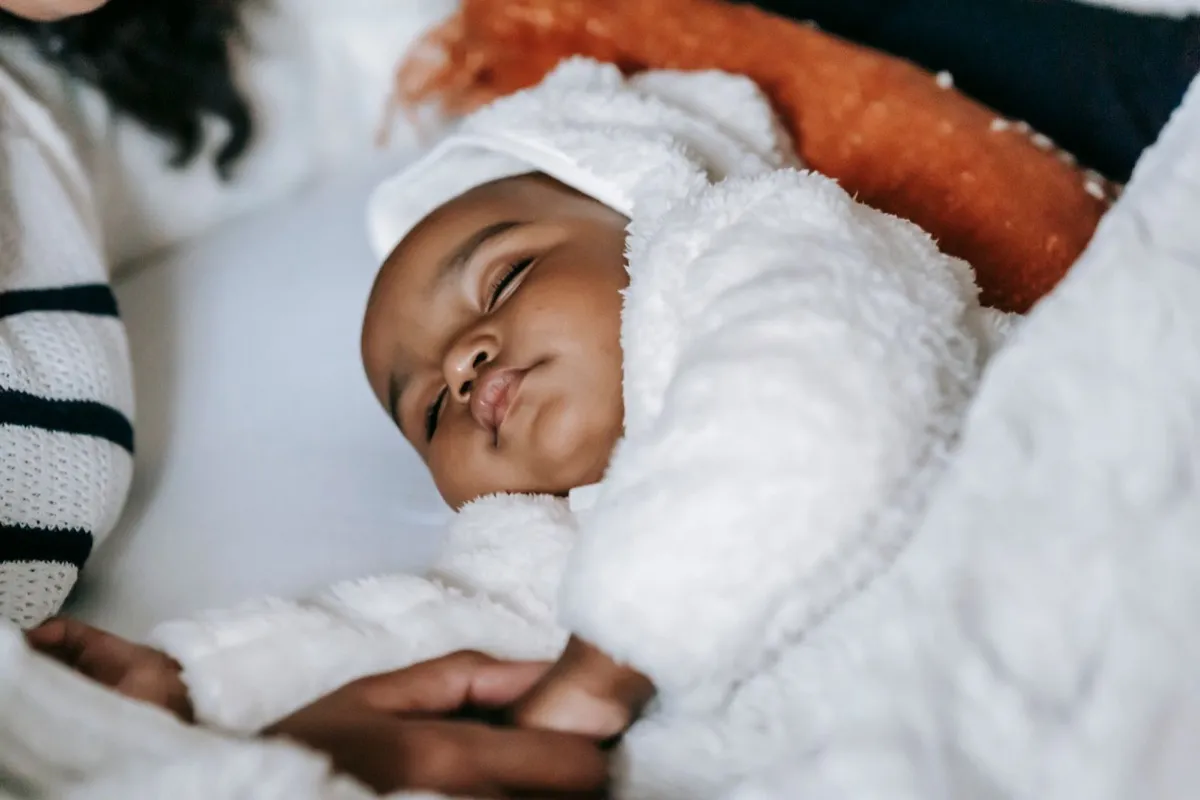
What Normal Infant Sleep Looks Like
Normal infant sleep varies far more than most parents expect. A systematic review of 34 studies by Galland and colleagues found that infants slept an average of 12.8 hours a day. The normal range was 9.7 to 15.9 hours. The table gathers the main reference points for the first year.
| Source | What it found |
|---|---|
| Galland and colleagues, 2012 (34 studies) | Infants slept 12.8 hours a day on average, within a range of 9.7 to 15.9 hours that covers most infants; night wakings ranged from 0 to 3.4 per night in the first two months |
| American Academy of Sleep Medicine, 2016 | 12 to 16 hours per 24 hours, including naps, for babies aged 4 to 12 months; no figure for under 4 months because of the wide range of normal variation |
| Henderson and colleagues, 2010 (75 infants) | The largest gain in self-regulated sleep came between 1 and 4 months; at 12 months, 11 of the 75 infants had still not met the midnight to 5 am or the 8-hour definition of sleeping through |
| Paavonen and colleagues, 2020 (two birth cohorts) | Sleep latency, the time taken to fall asleep, shortened by 6 months, and night-time sleep consolidated during the second year; parent-reported sleep problems stayed common throughout |
| Goodlin-Jones and colleagues, 2001 (80 infants) | Most infants woke at night at every age, and even at 12 months about half typically needed a parent to get back to sleep |
Sleeping through the night also depends on the definition. In Henderson’s diary study, half of infants met the midnight to 5 am and the 8-hour criteria by 3 months. Half met the 10 pm to 6 am criterion only by 5 months.
Sleeping through is a moving target.
Why Babies Resist Sleep
Babies resist sleep for developmental, environmental and health reasons. These often overlap. Sleep regulation is still maturing. That is why falling asleep gets easier by around 6 months and night-time sleep consolidates later. Many parents feel the difficulty is theirs alone. Part of it reflects where the baby is on that curve.
Bedtime conditions matter too. Mindell’s 2015 study of the mothers of 10,085 children aged 0 to 5 years found that a consistent bedtime routine was associated with earlier bedtimes, shorter sleep onset latency, fewer night wakings and longer sleep. More consistent routines went with better outcomes. The data came from questionnaires. The link is an association and does not prove cause.
Health can also be the reason. A baby in discomfort, for example from reflux, may resist being laid down. The page on bringing up milk after feeds explains when that pattern is normal.
Published research does not give a fixed wake-time rule for individual babies. The sleep medicine consensus itself notes wide normal variation, particularly under 4 months. Every baby runs on their own clock.
What the Research Supports for Settling a Baby
Behavioural approaches have the largest body of research behind them. The review below covered young children with bedtime problems and night wakings. Its abstract gives no age limits. Ask your doctor or paediatrician whether and when any method suits your baby, and how old your baby needs to be first.
A review for the American Academy of Sleep Medicine by Mindell and colleagues covered 52 treatment studies. In 94% of the studies the behavioural interventions were reported as efficacious. More than 80% of treated children improved meaningfully. The gains lasted 3 to 6 months.
| Approach | What the evidence shows | Caveat |
|---|---|---|
| Consistent bedtime routine | Associated with shorter time to fall asleep, fewer night wakings and longer sleep in 10,085 children (Mindell, 2015) | Questionnaire data; association only |
| Preventive parent education | Strong support in the AASM review of 52 studies | Evidence from a 2006 review; newer trials not assessed here |
| Graduated extinction, bedtime fading, scheduled awakenings | Supported in the same review | Not recommended under 6 months. Suitability depends on age and the family; discuss with your doctor, paediatrician or clinic sister |
| Unmodified extinction | Strong support for efficacy in the same review | Not recommended under 6 months. Evidence is from young children; ask your doctor or paediatrician before trying it |
| Infant craniosacral therapy | No trial for infant sleep located; sleep outcomes in a 2018 review of manual therapy for crying infants were inconclusive | Evidence limited |
The one South African study located is small and preliminary. Muller and Guse’s 2024 study followed 119 mothers who approached a South African sleep consultancy. It compared scores before and about 3 weeks after graduated extinction or extinction with parental presence. The findings suggest life satisfaction, affect, stress and depression may improve in the short term. Couple satisfaction did not. The study had no control group.
The best-tested answers in infant sleep are the plain ones.
What Most Parents Get Wrong About Infant Sleep
Online infant sleep advice tends to set a single target and ignore how widely normal babies vary. That leaves exhausted parents choosing between guilt and shortcuts. The list below covers five pitfalls that the research or safe-sleep policy speaks to directly.
- “Sleeping through” shifts by definition, so a baby who sleeps midnight to 5 am has met one standard and missed another.
- Using an inclined or soft sleep surface. Always place your baby on their back to sleep, on a firm, flat cot mattress with no pillows, bumpers, toys or loose blankets. Room-share rather than bed-share for at least the first 6 months. Avoid overheating and smoke exposure.
- The Mindell 2015 data linked more consistent routines with better sleep, so the same short sequence each night is worth protecting even on hard nights.
- Dismissing a sudden change. Fever, unusual drowsiness, poor feeding, difficulty breathing or apparent pain alongside disturbed sleep calls for a doctor, not a sleep strategy.
- Ignoring your own state. In the South African study, mothers of children with sleep problems reported moderate negative affect and stress and mild depression, so persistent low mood belongs with a GP.
Infant Craniosacral Therapy and Sleep: What Research Shows
Research has not shown that craniosacral therapy improves infant sleep. In a 2018 review of manual therapy for unsettled, crying infants, Carnes and colleagues rated the sleep evidence inconclusive. A 2024 systematic review found no benefit of craniosacral therapy for infant colic.
Before any infant session at The Reset Room, Dr Safeera conducts a full clinical assessment and adapts the approach to the individual baby. Infant craniosacral therapy uses extremely light touch. It is offered as a complement to medical care, alongside the sleep basics above. No outcome is promised.
If your baby’s sleep keeps worrying you, bring it to your doctor. Your own tiredness counts too.
Ask about infant craniosacral therapy
Doctor-led assessment, alongside your baby’s own medical care.
The Reset Room, Houghton Estate, Johannesburg.
Frequently Asked Questions
Why is my baby fighting sleep?
Babies fight sleep for several reasons: sleep regulation that is still maturing, wide natural variation in sleep, inconsistent bedtime conditions, and sometimes discomfort or illness. A baby who also feeds poorly, has a fever or seems to be in pain needs a doctor’s review before any sleep strategy.
How much sleep does a baby need?
The American Academy of Sleep Medicine recommends 12 to 16 hours per 24 hours, including naps, for babies aged 4 to 12 months. It gives no figure below 4 months because normal sleep varies widely. A systematic review of 34 studies put the normal range for infants at 9.7 to 15.9 hours.
When do babies start sleeping through the night?
The answer depends on how sleeping through is defined. In a diary study of 75 infants, half slept from midnight to 5 am by 3 months and from 10 pm to 6 am by 5 months. In another study, about half of 12-month-olds still typically needed a parent’s help to resettle.
Is it a problem if my baby fights sleep every night?
Fighting sleep every night can fall within normal development, but it deserves a doctor’s review when it comes with fever, poor feeding, difficulty breathing, unusual drowsiness or apparent pain. The American Academy of Sleep Medicine advises parents who worry about too little sleep to consult their healthcare provider.
Can infant craniosacral therapy help a baby sleep?
Research has not shown that craniosacral therapy improves infant sleep. A 2018 review of manual therapy for unsettled infants rated the sleep evidence inconclusive, and a 2024 systematic review found no benefit for infant colic. The Reset Room offers infant craniosacral therapy only as a complement to medical care, with no outcome promised.
Disclaimer. General health information, not medical advice. A baby with fever, poor feeding, difficulty breathing, unusual drowsiness or apparent pain needs medical review, and persistent low mood in a parent should be raised with a doctor.