
A baby who only looks one way usually has a postural preference or congenital muscular torticollis. Have a doctor and a paediatric physiotherapist assess it as soon as you notice.
Torticollis is a shortened neck muscle. Both it and a simple postural preference are common. Earlier assessment is linked to shorter treatment. On infant craniosacral therapy (CST), the main physiotherapy guideline found no published studies for this condition.
If you have spotted this, you are not alone. Which way does your baby settle when you are not trying to steer them?
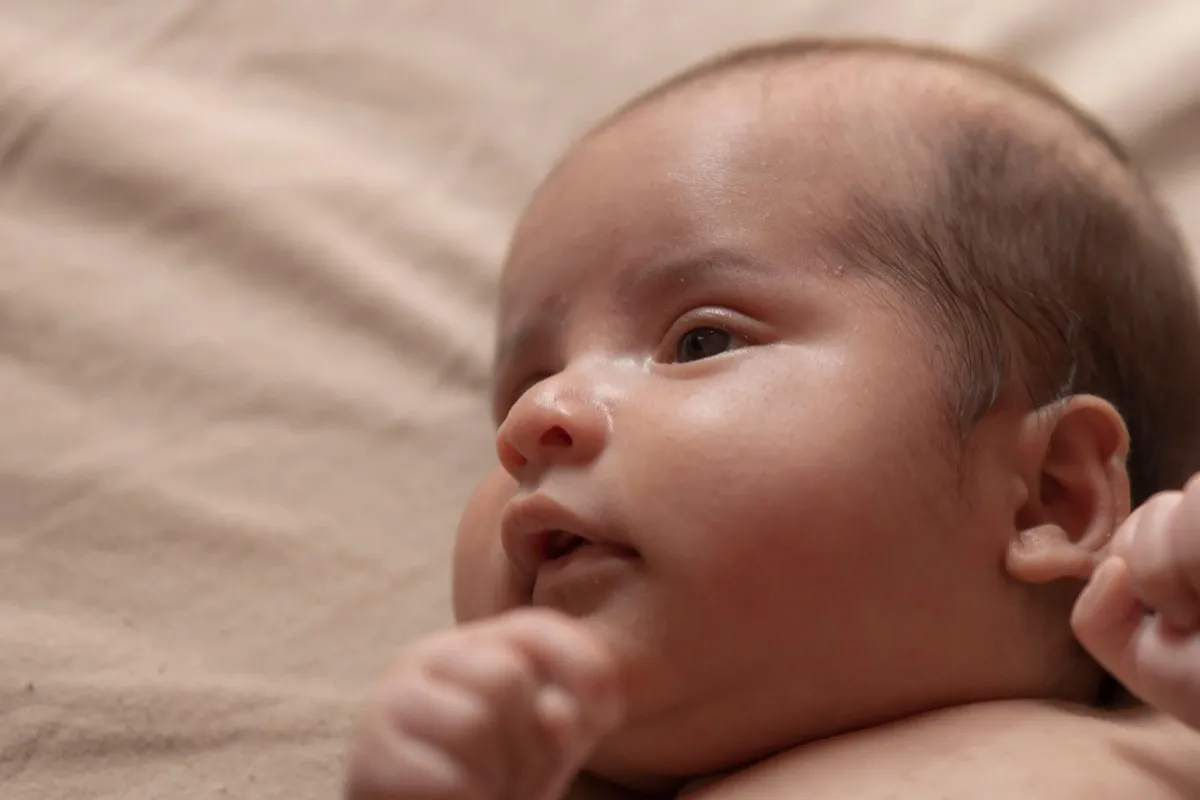
What Is Behind a Baby Who Favours One Side
Most babies who favour one side have either a habit of turning that way or congenital muscular torticollis (CMT). The American Physical Therapy Association guideline describes CMT as unilateral shortening of the sternocleidomastoid muscle in the neck. The head tilts toward one side and turns toward the other. The American Academy of Pediatrics (AAP) calls CMT by far the most common cause of head tilt in children under five.
| Possible cause | What it involves |
|---|---|
| Postural preference | A baby who habitually turns the head one way, often with a flat spot developing on that side |
| Congenital muscular torticollis | A tight sternocleidomastoid muscle. It commonly results from positioning in the womb, and rarely from birth, particularly breech and difficult first-time deliveries. About half the time a small lump can be felt in the muscle |
| Other causes, uncommon | Hearing loss, misalignment of the eyes, reflux, a throat or lymph node infection and, very rarely, a brain tumour |
Torticollis is usually detected in the first six to eight weeks after birth, according to the AAP. In Stellwagen and colleagues’ study of 102 healthy newborns examined in hospital, 16% had torticollis. Also, 73% had at least one asymmetry of the head, face or jaw. Torticollis was associated with the mother reporting the baby had been stuck in one position in the womb for more than 6 weeks before delivery.
Signs That Suggest Torticollis
The signs of torticollis are a head held to one side and a baby who turns the same way every time. A single sign does not confirm it. Several together are a reason to book an assessment. The AAP describes these signs in babies:
- The head leans toward one shoulder and looks toward the opposite side
- The same side of the face turns toward the mattress when lying on the tummy
- One side of the head flattens, and the face can look uneven or out of line
- A small lump can be felt in the neck muscle in about half of cases
The AAP estimates that 85% of babies with torticollis also have a positional skull deformity. A flat spot on the head often travels with the tilt. Treating the flat spot alone misses the neck.
Some babies with torticollis also have developmental dysplasia of the hip. That is why a doctor may order a hip ultrasound or X-ray.
Why Early Assessment Changes How Long Treatment Takes
Treatment lasted longer in babies who started physiotherapy later. Petronic and colleagues studied 980 children with torticollis treated at a Serbian university children’s hospital. They found that median physiotherapy lasted 1.5 months when it began before one month of age. It lasted 10.3 months when it began after 12 months.
| Age when physiotherapy started | Median treatment duration |
|---|---|
| Under 1 month | 1.5 months |
| 1 to 3 months | 5.9 months |
| 3 to 6 months | 7.2 months |
| 6 to 12 months | 9.8 months |
| Over 12 months | 10.3 months |
The 2018 guideline from the American Physical Therapy Association’s Academy of Pediatric Physical Therapy summarises the same study. When treatment began before one month, 99% of babies had an excellent outcome (no head tilt and full passive neck rotation). When it began at 6 to 12 months, the figure was 19%.
The guideline also states that the rate of spontaneous resolution is unknown. No documented method predicts which babies will resolve and which will progress to more persistent forms. That is why it advises referring any baby with a postural preference, reduced neck movement, a neck lump or facial asymmetry to a doctor and an infant physiotherapist. The advice is to do it as soon as the asymmetry is noticed.
Waiting is the choice that costs time.
What Treatment Involves
Physiotherapy is the first-choice treatment for torticollis, and it goes beyond stretching. The guideline lists five components: passive neck range of motion, active neck and trunk movement, development of symmetrical movement, environmental adaptations and parent education. Parents learn gentle exercises to do several times a day, as the AAP describes.
At home, the AAP suggests placing the things your baby wants to look at on the side away from the tight muscle. Windows, mobiles and pictures all work. The baby stretches while looking. Supervised tummy time while awake also matters, and the guideline recommends it 3 or more times daily. Babies still sleep on their backs.
If exercise and positioning do not correct the problem, the AAP says a paediatric neurologist or orthopaedic specialist may become involved. In some cases the tendon is lengthened surgically. A physiotherapist who sees a baby not progressing as expected is advised to consult the baby’s doctor.
Where Infant Craniosacral Therapy Fits
The 2018 physiotherapy guideline found no peer-reviewed studies describing the effect of craniosacral therapy on torticollis. It said its group could not recommend CST for managing the condition at that time. The guideline names massage as a single modality, with Total Motion Release and Feldenkrais in the same category.
A 2020 review of systematic reviews by Ellwood and colleagues found moderate favourable evidence for practitioner-led stretching in increasing neck range of movement. Its manual therapy category covered chiropractors, osteopaths and physiotherapists, not CST specifically. The review also noted case reports of serious harm after cervical spine manipulation in infants.
Dr Safeera Kholvadia, a medical doctor, sees babies at The Reset Room in Houghton Estate. Her infant craniosacral therapy page describes a full clinical assessment before every session and extremely light touch. Any hands-on work is complementary. For a baby with suspected torticollis it should follow a paediatric examination and sit alongside physiotherapy, not replace it. No outcome can be promised.
The first step is an initial consultation. If a physiotherapist has already seen your baby, bring their notes. The conversation can then start from the diagnosis already made.
What Most Parents Get Wrong About a Baby Who Favours One Side
The usual errors treat a head preference as a habit that will fade. Others reach for a therapy the guideline could not recommend. Both delay the right assessment. The table above shows how treatment time rose with a later start. Five mistakes recur:
- Waiting to see if it passes. The guideline says spontaneous resolution is unknown and cannot be predicted, and later starts were linked to longer treatment.
- Treating only the flat spot. The flat spot may be a result of the neck preference, so the neck needs examining too.
- Forcing the head to turn. The AAP describes gentle movement taught by a doctor, and the guideline places stretching inside a full physiotherapy plan.
- Assuming it must be torticollis. The AAP lists eye, hearing and reflux causes, which only an examination can separate.
- Choosing a therapy the guideline could not recommend first. The 2018 guideline found no peer-reviewed studies of CST for torticollis, so physiotherapy comes first.
If your baby keeps favouring one side, book the assessment. Asking early is part of good care.
Book an infant consultation
Doctor-led assessment and infant craniosacral therapy.
The Reset Room, Houghton Estate, Johannesburg.
Frequently Asked Questions
Why does my baby only look to one side?
A baby who only looks to one side usually has a postural preference or congenital muscular torticollis, a shortened neck muscle. Both are common in the first weeks. Less often, eye, hearing or reflux problems are involved, so a paediatrician should examine any baby who consistently favours one side.
Will torticollis go away on its own?
Torticollis may or may not resolve alone, and the American Physical Therapy Association guideline says no documented method predicts which. Because earlier physiotherapy is linked to shorter treatment, waiting to see is not advised. A paediatrician or paediatric physiotherapist can assess your baby and say whether treatment is needed.
How long does torticollis treatment take?
Torticollis treatment time depends mainly on the age at which physiotherapy starts. In a Serbian study of 980 children, median treatment lasted 1.5 months when it began before one month of age, 5.9 months at 1 to 3 months, and 9.8 months at 6 to 12 months.
Can craniosacral therapy help torticollis?
The 2018 physiotherapy guideline found no peer-reviewed studies of craniosacral therapy for torticollis and could not recommend it. Physiotherapy is the first-choice treatment. Any hands-on therapy such as CST should follow a medical assessment and sit alongside physiotherapy, never replace it.
Is a baby only looking one way an emergency?
A baby who only looks one way is rarely an emergency, but the habit needs assessment soon. A sudden head tilt, a painful neck or a baby who seems unwell needs urgent medical review. Otherwise, book a paediatric check as soon as you notice the preference.
Disclaimer. General health information, not medical advice. A baby who tilts or turns the head to one side should be examined by a paediatrician and, where advised, a paediatric physiotherapist. Seek urgent review if your baby is unwell or the tilt starts suddenly.