
The craniosacral rhythm is a slow pulse that craniosacral practitioners say they can feel through the head and sacrum. Research has not established what the rhythm is.
The Upledger Institute describes it as the rhythm of the cerebrospinal fluid pulsing around the brain and spinal cord. In reliability studies, trained examiners palpating the same people agreed poorly on its rate.
Cerebrospinal fluid does move in the body, and MRI studies have measured that movement. The open question is whether examiners can reliably feel a distinct rhythm, and whether it is the one the method describes. What would count as good enough evidence for you?
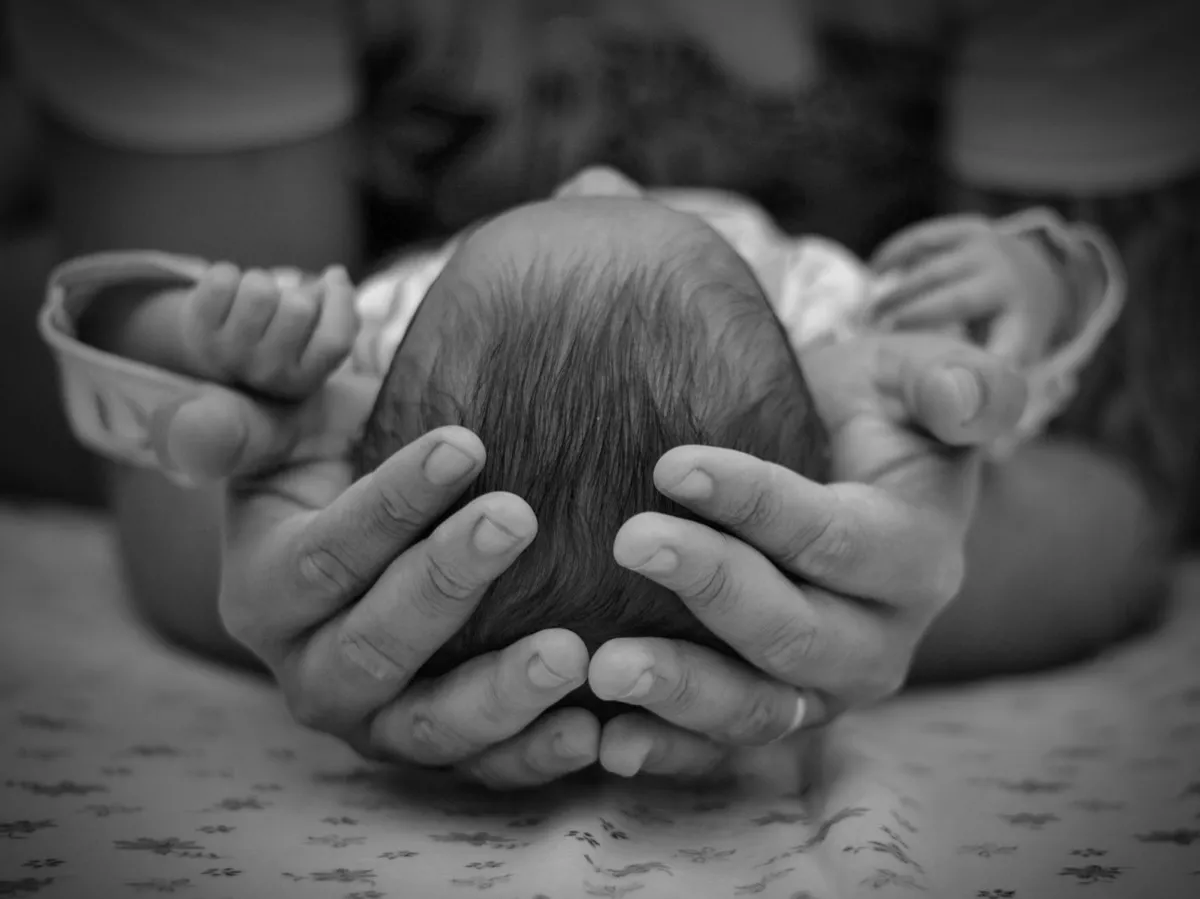
What Practitioners Mean by the Craniosacral Rhythm
The Upledger Institute trains practitioners in craniosacral therapy. It says the practitioner evaluates the craniosacral system by gently feeling various locations of the body. The aim is to test for the ease of motion and rhythm of the cerebrospinal fluid pulsing around the brain and spinal cord. The Institute traces the idea to John Upledger’s observation of a rhythmic movement during neck surgery in 1970. The older root is William Sutherland’s cranial osteopathy.
Osteopathy uses other names for the same idea. A 2024 systematic review by Mériaux and colleagues defines the cranial rhythmic impulse as a movement felt on the scalp. It defines the primary respiratory mechanism as the corresponding movement felt on the rest of the body. Sutherland proposed in 1939 that it was due to the movement of the cranial bones pulled by the meninges, pushed by fluctuation of the cerebrospinal fluid.
The Reset Room’s craniosacral therapy page uses similar language. It describes work with the craniosacral rhythm as the subtle tide that moves through the cerebrospinal fluid. That is the practice’s description. The studies below test whether such a rhythm can be reliably felt.
Can Two Examiners Feel the Same Rhythm?
Five studies, published between 1994 and 2004, asked trained examiners to palpate the rate of the rhythm in the same people. They compared the results. Agreement between examiners was poor in all five. The authors of the earliest drew a pointed conclusion about clinical decisions based on it. The table sets out each design and result in the authors’ words.
| Study | Design | Agreement between examiners | Authors’ conclusion |
|---|---|---|---|
| Wirth-Pattullo and Hayes, 1994 | 12 children and adults; three physical therapists with craniosacral expertise | ICC -0.02; rates not significantly related to heart or respiratory rates | Therapists were not able to measure it reliably; measurement error may make many clinical decisions potentially erroneous |
| Hanten and colleagues, 1998 | 40 healthy adults; two examiners | Inter-examiner 0.22; intra-examiner 0.78 and 0.83 | It is possible that the perception is illusory |
| Rogers and colleagues, 1998 | 28 adults; two craniosacral examiners palpating head and feet together | Inter-rater ICC 0.08 at the head and 0.19 at the feet; intra-rater 0.18 to 0.30; head and feet rates differed | Results did not support the theories behind craniosacral therapy or claims that the motion can be palpated reliably |
| Moran and Gibbons, 2001 | 11 healthy people; two osteopaths palpating head and sacrum | Inter-examiner -0.09 to +0.31; intra-examiner 0.52 to 0.73 | Results fail to support the core-link hypothesis as traditionally held |
| Sommerfeld and colleagues, 2004 | 49 healthy people palpated simultaneously at head and pelvis | Inter- and intra-examiner agreement could not be described beyond chance | Rates could not be palpated reliably and were influenced by the examiners’ own breathing under some conditions; results do not support the hypotheses behind the mechanism |
The pattern across the table is that examiners did not agree with each other. In two of the five studies (Hanten; Moran and Gibbons) each examiner was fairly consistent with themselves, at 0.52 to 0.83. Rogers’ team reported low intrarater values of 0.18 to 0.30. Sommerfeld’s team found intra-examiner agreement no better than chance. Hanten’s team noted that a single examiner may be able to palpate the rate consistently, if that is what was truly measured.
Consistency within one person does not show that two people are feeling the same thing. The 2016 systematic review of cranial osteopathy by Guillaud and colleagues concluded that its diagnostic procedures are unreliable in many ways.
Reading the numbers needs one convention. The intraclass correlation coefficient (ICC) runs from 1, which is perfect agreement, down towards 0. Values near or below 0 mean essentially no agreement. The designs also kept examiners apart. Rogers’ team hung a privacy curtain over each subject’s waist. Moran and Gibbons had two blinded osteopaths mark the full-flexion phase on silent foot switches linked to a computer.
In Hanten’s study the authors concluded that the palpated rate appeared unrelated to the heart or respiratory rates of subjects and examiners. The abstract also reports that one examiner’s rates were significantly associated with those rates in a regression (p = 0.001) while the other’s were not. Neither result validated the other.
Wirth-Pattullo and Hayes found low, nonsignificant correlations. Sommerfeld’s team found no correlation with the subjects’ breathing. They did find a significant effect of the examiners’ own breathing under some conditions. The evidence therefore does not support the pulse or the breath as the source. It does not exclude it either.
What Is Measurably Moving: Cerebrospinal Fluid Flow
Real-time MRI can measure cerebrospinal fluid flow in living people. The results link it to breathing and, in one study, more weakly to the heartbeat. In Dreha-Kulaczewski and colleagues’ 2015 study of healthy volunteers, significant fluid flow occurred exclusively with inspiration. Breath holding suppressed it, and only a minor component could be ascribed to cardiac pulsation. The authors state that the mechanisms of human CSF flow are still not fully known.
They expect the fall in chest pressure during inspiration to alter the hydrostatic pressure on the venous and lymphatic routes that drain the fluid. That is the authors’ proposed explanation for the finding. It concerns drainage and not any palpable rhythm.
Laganà and colleagues’ 2022 study of 30 healthy volunteers, measured at the first cervical level, found that the frequencies of the high and very high spectral peaks in blood and cerebrospinal fluid flow corresponded to the respiratory and cardiac frequencies. Deep breathing increased the respiratory modulation.
These studies show that fluid flow is real and that it is linked to breathing and the heartbeat, with inspiration the larger component in the 2015 study. They did not test what a practitioner feels through the skull. They neither confirm nor refute the palpated rhythm. They do suggest that a rhythm independent of breath and pulse would need its own evidence.
Competing Explanations for What Examiners Feel
Researchers have proposed several explanations for the sensation, and none has won agreement. Mériaux and colleagues reviewed 28 articles and reported that 20 referenced at least one of Sutherland’s hypotheses, often to critique or challenge it. The table lists the main explanations with the status each holds in the sources reviewed here.
| Explanation | What it proposes | Status in the sources opened |
|---|---|---|
| Sutherland’s model | Cranial bones move, pulled by the meninges and pushed by cerebrospinal fluid fluctuation | The authors of Mériaux’s 2024 review describe scientific progress as refuting it, though it remains prevalent in general belief |
| Traube-Hering-Mayer oscillation | The palpated impulse coincides with the Traube-Hering-Mayer oscillation, a low-frequency fluctuation measured by laser-Doppler flowmetry | Nelson and colleagues (2001; sample size not stated in the abstract) found the impulse palpably concomitant with low-frequency fluctuations measured by laser-Doppler flowmetry; Mériaux’s 2024 review says it has gained prominence as the leading hypothesis, with 20 of its 28 articles discussing it |
| Entrainment | The palpable impulse reflects the harmonising of several biological oscillators, derived primarily from signals between the sympathetic and parasympathetic nervous systems | Proposed by McPartland and Mein (1997) as a hypothesis, without data in the abstract |
| Breathing and heart rate | The impulse follows ventilation or cardiac rhythm | Wirth-Pattullo and Hayes found low, nonsignificant correlations; Hanten and colleagues concluded the palpated rate appeared unrelated, although one examiner’s regression reached significance (p = 0.001) and the other’s did not; Sommerfeld’s team found an effect of the examiners’ own breathing under some conditions |
A 2024 feasibility study of dynamic MRI in 15 healthy people by Masoudi and colleagues reported measurable rhythmic movement between skull landmarks. It called this a potential way to measure the impulse, while noting that amplitude was dependable for only one of the three distances. Its abstract does not say what the movements correspond to physiologically. It is a measurement-feasibility result and not an explanation.
The 2024 systematic review by Mériaux and colleagues also found that vasomotion, heart rate variability and ventilation rate were each discussed in the literature. No study had three good-level items for methodological rigour. Its authors concluded that the field needs more rigorous evaluation and communication. That is a sober summary: several hypotheses, thin evidence, and no settled account of the rhythm’s origin.
What Most People Get Wrong About the Craniosacral Rhythm
A sensation can be genuine to the person feeling it without its source being confirmed. Hanten’s authors wrote that it is possible the perception is illusory. That statement leaves open that examiners feel something real whose origin is unknown. The evidence does not allow a confident claim in either direction about what the sensation is.
Agreement with oneself is easy to mistake for agreement with reality. In two studies examiners were fairly consistent over repeated palpations of the same person and still disagreed with a colleague. A practitioner’s confidence in what they feel is not the same as shared, checkable evidence. Not every cranial assessment fared as badly. Halma’s 2008 study found substantial self-agreement for cranial strain patterns in 48 people, though its authors called the results less promising for the rhythm itself.
Measured cerebrospinal fluid movement does not prove the palpated rhythm. MRI studies show flow linked to breathing and the heartbeat. The craniosacral rhythm as described is a claim about something palpable at the head and sacrum. Reading the MRI results as confirmation, or the agreement studies as proof that nothing moves, goes beyond both bodies of evidence.
What the Rhythm Question Means for Therapy
The agreement studies concern assessment, meaning whether examiners can read a rhythm. Clinical trials concern treatment, meaning whether people improve after sessions. The two questions are related but separate. The article on what craniosacral therapy is sets out the clinical reviews, which are mixed. The article on craniosacral therapy and the autonomic nervous system covers a proposed mechanism.
Dr Safeera Kholvadia, a medical doctor, offers craniosacral therapy at The Reset Room in Houghton Estate, Johannesburg. It is a complement to medical care, using very light touch at the head, sacrum and along the spine. The practice’s craniosacral therapy page describes the service. Nothing above establishes that its sessions depend on, or confirm, a palpable rhythm.
Frequently Asked Questions
What is the craniosacral rhythm?
The craniosacral rhythm is a slow pulse that craniosacral practitioners say they feel at the head and sacrum. The Upledger Institute describes it as the rhythm of the cerebrospinal fluid pulsing around the brain and spinal cord. Osteopathy calls it the cranial rhythmic impulse, and research has not established its origin.
Can a practitioner really feel the craniosacral rhythm?
Practitioners report feeling it, but trained examiners agree poorly with each other. Hanten and colleagues’ 1998 study of 40 adults found inter-examiner reliability of 0.22 and wrote that the perception may be illusory. Moran and Gibbons’ 2001 study found values from -0.09 to +0.31, so these studies did not support reliable palpation.
Is the craniosacral rhythm the same as the heartbeat or breathing?
Palpation studies did not clearly find that. Wirth-Pattullo and Hayes found low, nonsignificant correlations between the palpated rate and heart or respiratory rates, and Hanten and colleagues concluded the two were unrelated, although one examiner’s results reached significance. Separately, MRI studies link measured cerebrospinal fluid flow to breathing and the heartbeat.
Does cerebrospinal fluid move in a rhythm?
Cerebrospinal fluid does move, and real-time MRI has measured it. Dreha-Kulaczewski and colleagues found significant flow exclusively with inspiration and only a minor cardiac component in healthy volunteers. These findings describe measured flow and do not confirm the rhythm that practitioners say they palpate.
Does craniosacral therapy work if the rhythm is unreliable?
Research has not settled this. Rhythm palpation concerns assessment, while clinical reviews test treatment. A 2019 meta-analysis found benefit for chronic pain, and 2024 reviews of 15 and 24 trials found no significant benefit. An unreliable assessment signal does not by itself disprove an effect, and it does not support one.
Disclaimer. General health information, not medical advice. Craniosacral therapy is a complementary approach and does not replace medical diagnosis or treatment.