
A body that never relaxes is often a body whose nervous system is held on low-grade alert.
Heart rate, breathing and muscle tone can stay raised when nothing is wrong. The signals coming from the body are often read less accurately. Here, body-mind disconnection means that second part. It is closely related to what researchers call interoception.
You can know you are safe and still feel no ease. Relaxation is a nervous-system state. A decision cannot switch it on. If this sounds like you, you are not alone. When did your body last feel fully off duty?
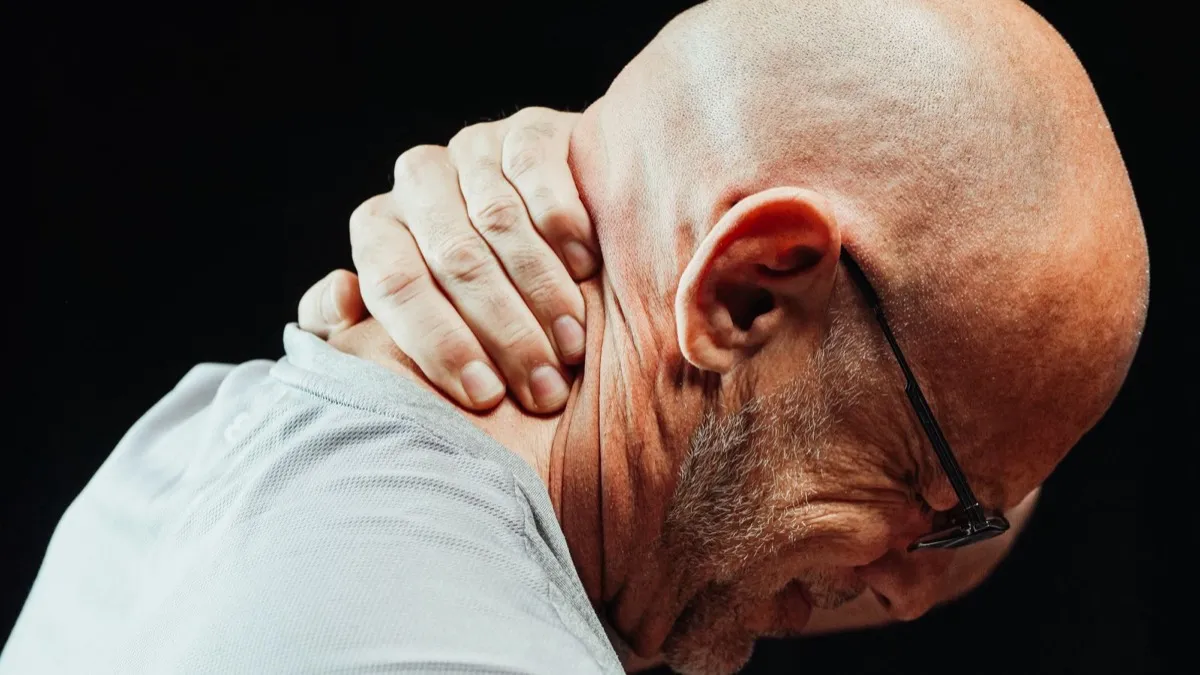
Why the Body Stays On When the Mind Wants Off
Relaxation is an autonomic state, so willpower alone rarely switches it off. Resting heart rate variability reflects how flexibly the vagus nerve controls the heart. It is often lower in people with anxiety disorders. In a 2014 meta-analysis, Chalmers and colleagues pooled 36 studies. They covered 2,086 patients and 2,294 healthy controls.
Anxiety disorders were associated with lower resting heart rate variability, with a small-to-moderate effect (Hedges’ g of -0.29 for the high-frequency measure and -0.45 for the time-domain measure). High-frequency variability was lower in panic disorder, post-traumatic stress disorder, generalised anxiety disorder and social anxiety disorder. It was not lower in obsessive-compulsive disorder.
That finding is an association in people with diagnosed anxiety disorders. It does not show that every tense body has the same pattern. It does fit what a nervous system stuck in chronic fight-or-flight looks like from the inside. The body cannot drop out of readiness.
How Body-Mind Disconnection Develops
In this article, body-mind disconnection means reduced or distorted awareness of signals from inside the body. It is closely related to interoception. Khalsa and colleagues’ 2018 roadmap defines interoception as the way the nervous system senses, interprets and integrates signals from within the body. It notes that disturbed interoception is increasingly recognised in anxiety, mood, eating, addictive and somatic symptom conditions.
Paulus and Stein’s 2010 review described increased but noisy signals from the body, interpreted through expectation and belief, as part of how anxiety and depression alter bodily awareness. In everyday terms, the body sends a lot of signal. The brain predicts danger. The reading becomes less reliable.
Static on the line makes every message harder to read.
Disconnection can look like missing hunger, tiredness or tension until they are severe. It can also look like noticing every flutter of the heart and treating it as a threat. Feeling detached from yourself or unreal is a different experience. It is called dissociation, and it needs its own assessment.
Signs the Body Is Not Settling
The signs are physical and mostly show when the day should be winding down. None of these is a diagnosis. The pattern across several matters more than any one item. They describe a body that is not settling. They are pointers rather than findings from a study.
- Hunger, tiredness or thirst that you notice only when they are severe
- Breathing that stays shallow and high in the chest
- A heart rate or inner buzz that stays noticeable while you sit still
- Surprise at how tense you are when someone points it out
- Light sleep, early waking or waking unrefreshed
- Tiredness that comes with a restless, wired feeling
Your body keeps sending notes. Most of us stop reading them.
Tension that keeps returning has its own explanation in why the body keeps holding tension, including what research does and does not show about fascia.
Sleep: Where a Body That Never Relaxes Shows at Night
Hyperarousal is a state of raised physiological, cortical and cognitive-emotional activity. It features in or sits at the centre of many models of insomnia. Dressle and Riemann’s 2023 review found supporting evidence for cognitive-emotional hyperarousal and for raised cortical activity on EEG. Neuroendocrine variables are increasingly implicated.
The same review found no conclusive evidence for heart rate or heart rate variability involvement in insomnia. The physiological side of night-time arousal is less settled than the cognitive side. It is a theoretical review. The authors call for longitudinal studies.
A tired body and a wired body can share the same bed.
When Trying to Relax Makes Things Worse
Relaxation-induced anxiety is a recognised paradox. Some people experience a spike in anxiety during relaxation training. Kim and Newman’s 2019 study exposed 32 people with generalised anxiety disorder, 34 with major depressive disorder and 30 healthy controls to relaxation practice. It measured the response.
They found that sensitivity to sharp negative emotional contrast statistically accounted for all of the link between generalised anxiety disorder and relaxation-induced anxiety. It accounted for part of the link in depression. The underlying contrast avoidance model proposes that some people stay on edge. Relaxing makes any sudden negative emotion feel sharper by contrast.
A body can react to relaxation as if it were a threat. If that happens to you, you have not failed. It is a known response. Mention it to the clinician guiding you.
What Most People Get Wrong About a Body That Will Not Relax
Effort is the usual trap. A nervous system that has run on alert for months does not respond to an instruction. The common approaches below all leave untouched the drive that keeps the body there. Four are worth testing against your own habits.
- Forcing relaxation with willpower, which adds effort to a system already working too hard
- Pushing through relaxation-induced anxiety instead of changing the approach
- Assuming the cause is purely psychological, when physical causes such as medication effects and sleep disorders also need excluding
- Reading the absence of felt tension as the absence of tension, when disconnection can hide it
Trying harder to relax is still effort.
What Helps a Body That Will Not Settle
Settling a body that stays on alert starts with a medical check. Work that trains the nervous system to move out of alert follows. Slow breathing is one self-help tool with early evidence. Zaccaro and colleagues’ 2018 systematic review of 15 studies in healthy people found that breathing below 10 breaths a minute increased heart rate variability. It was linked with more comfort and relaxation and less arousal and anxiety.
Hopper and colleagues’ 2019 review of diaphragmatic breathing found only three studies. One was a randomised trial and two were quasi-experimental. All showed reduced stress, with small samples. The evidence is early. Slow breathing is a practice, not a treatment.
Dr Safeera Kholvadia, a medical doctor (MB BCh, MBA) at The Reset Room in Houghton Estate, works with this pattern through nervous system regulation and craniosacral therapy, as complements to medical care.
If your body won’t switch off, start with a medical check and go gently. You are allowed to rest.
Get help with a body that will not settle
Doctor-led consultation and nervous system regulation.
The Reset Room, Houghton Estate, Johannesburg.
Frequently Asked Questions
Why does my body never relax?
A body that never relaxes usually has a nervous system held in a low-grade alert state. Anxiety disorders are associated with lower resting heart rate variability, according to a 2014 meta-analysis of 36 studies. Persistent tension and poor sleep deserve a medical assessment to exclude physical causes before any pattern is assumed.
What is body-mind disconnection?
In this article, body-mind disconnection means reduced or distorted awareness of internal body signals such as hunger, tiredness, heartbeat and tension, which is closely related to interoception. A 2018 roadmap by Khalsa and colleagues describes disturbed interoception as a component of anxiety, mood and somatic symptom conditions. It differs from dissociation, which involves feeling detached from yourself.
Why do I feel more anxious when I try to relax?
Relaxation-induced anxiety is a documented response in which anxiety rises during relaxation practice. Kim and Newman’s 2019 study linked it to sensitivity to sharp negative emotional contrast in people with generalised anxiety disorder. The response is not a personal failure, and a clinician can adjust the approach.
Is something wrong with me if my body never relaxes?
A body that never relaxes can occur under sustained stress and is not a diagnosis in itself. Persistent symptoms, poor sleep or worsening anxiety warrant an assessment by a doctor or registered mental health professional. Assessment separates stress-driven arousal from medical causes and from conditions that need specific treatment.
What helps a body that will not relax?
Start with a medical check, then add slow breathing practice, sleep support and nervous system regulation work. Slow breathing below 10 breaths a minute raised heart rate variability in a 2018 review of 15 studies. Craniosacral therapy may be used as complementary care, with mixed research evidence behind it.
Disclaimer. General health information, not medical advice. If your body feels permanently on edge, your sleep is poor or your anxiety is worsening, see a doctor or a registered mental health professional.