
The vagus nerve is the tenth cranial nerve and the body’s main parasympathetic nerve. It slows the heart, drives digestion and controls swallowing and voice.
It also carries information from the organs back to the brain. Its functions are well described in anatomy and physiology. Many online claims about stimulating or resetting it go beyond the evidence. This guide builds on standard autonomic physiology. It does not rely on any one theory of how the nerve shapes emotion.
How much of what you have read about this nerve came with a source?
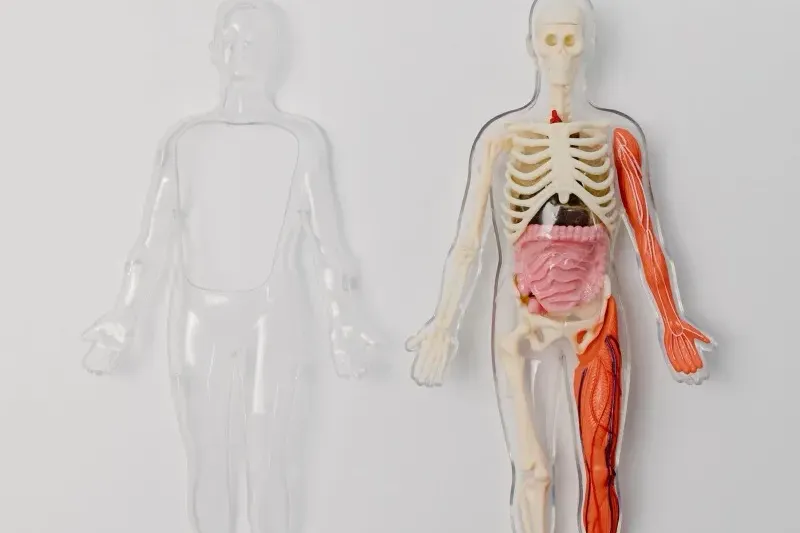
Where the Vagus Nerve Runs and What It Supplies
The vagus nerve extends from the brainstem through the neck and chest to the abdomen. Its long path earned it the name wanderer nerve. A 2018 review in Frontiers in Psychiatry by Breit and colleagues describes it as the main component of the parasympathetic nervous system. That system oversees functions including digestion, heart rate, immune response and mood control.
| Body area | What the vagus nerve does there | Source |
|---|---|---|
| Throat and voice box | Supplies most of the muscles of the pharynx and larynx, which handle swallowing and vocalisation | Breit and colleagues 2018 |
| Heart | Provides the main parasympathetic supply and reduces heart rate | Breit and colleagues 2018 |
| Airways | Takes part in regulating respiratory rate and in reflexes such as coughing | Breit and colleagues 2018 |
| Gut | Regulates contraction of smooth muscle and glandular secretion, and relays information about food and fuels to the brain | Breit and colleagues 2018 |
| Immune system | Part of an inflammatory reflex in which vagal signals help suppress cytokine release | Breit and colleagues 2018 |
Yuan and Silberstein’s 2016 review in Headache adds that the nerve has several brainstem nuclei. Most of its fibres are unmyelinated C-fibres from the visceral organs. It is also involved in inflammation, mood and pain regulation. The anatomy is standard. This table does not depend on polyvagal theory.
The Parasympathetic Role: Messages Down and Messages Up
The vagus nerve works as the main parasympathetic pathway. The parasympathetic and sympathetic systems act largely in opposition to regulate the body’s automatic functions. McCorry’s 2007 review in the American Journal of Pharmaceutical Education describes parasympathetic activity as dominant in quiet conditions, decreasing heart rate and stimulating gastric motility.
The nerve also carries information upward. Berthoud and Neuhuber’s 2000 review in Autonomic Neuroscience describes vagal afferent fibres supplying the oesophagus, lower airways, heart, aorta, the gastrointestinal tract, liver and pancreas. They carry sensors for stretch, chemicals, temperature and osmolarity. Breit and colleagues note that the vagus was historically studied as an efferent nerve, an outgoing pathway. It also sends information about the state of the inner organs to the brain through afferent fibres.
The page on nervous system dysregulation covers the autonomic nervous system more broadly. One theory divides the vagus into ventral and dorsal systems with separate emotional roles. That theory is contested. The page on polyvagal theory sets out both sides.
Medical Uses That Have Research Behind Them
Several medical uses of the vagus nerve are established or under study. They differ widely in evidence. The table covers the clinical uses and one device trial, with the study design and the main caveat for each. That keeps a clinical procedure apart from a wellness trend.
| Use | Evidence | Caveat |
|---|---|---|
| Implanted vagus nerve stimulation | The US FDA approved an implanted vagus nerve stimulator in 2005 as adjunctive long-term treatment for chronic or recurrent depression in adults who have not responded to four or more antidepressant treatments, and a 2018 review notes it is also approved for seizure prevention. The same review calls the evidence for add-on use in treatment-refractory depression, PTSD and inflammatory bowel disease preliminary, and says no randomised placebo-controlled trial reliably shows antidepressant effects | Requires surgery, the mechanism is unclear, and US approval is not South African regulatory status |
| Modified Valsalva manoeuvre for supraventricular tachycardia | In the REVERT trial of 433 adults, 43% returned to normal rhythm with the modified manoeuvre against 17% with the standard one (adjusted odds ratio 3.7) | Done in emergency departments under clinical supervision, in adults with this specific rhythm problem |
| Ear-based (transcutaneous auricular) stimulation for insomnia | A 2025 meta-analysis of 6 studies and 336 patients found improved sleep scores | Certainty of evidence was graded low to very low |
Vasovagal syncope, a faint whose name refers to the vagus, is a further medical connection. A 2024 review calls it benign in nature. It is a common reason for emergency visits and can cause injury. Management includes education and reassurance, extra salt and fluid and physical counter-pressure manoeuvres.
What Most People Get Wrong About the Vagus Nerve
Online material about the vagus nerve tends to promise more than the research delivers. It also leaves out functions that are well established. Five common misreadings follow. A source cited above corrects each one, and each is worth settling before you try any vagus nerve technique:
- Believing cold exposure, humming or gargling are proven vagus nerve exercises, when none of the sources opened for this guide tests them
- Calling it the relaxation nerve, when it also drives reflexes such as coughing, swallowing and vomiting
- Treating a wearable heart rate variability score as a vagus health score, when Laborde and colleagues warn that HRV findings are easily misconstrued
- Assuming the polyvagal map of ventral and dorsal functions is established, when 39 experts concluded in 2026 that the theory is untenable
- Ignoring a faint because the usual type is benign, when a 2024 review notes fainting can cause injury and NHS guidance advises seeing a GP after any faint
Heart Rate Variability and Vagal Tone
Heart rate variability (HRV) is the variation between heartbeats. Researchers use it as an index of cardiac vagal tone, the parasympathetic contribution to heart rate. Heart rate variability biofeedback trains breathing and heart rhythm. A 2017 meta-analysis of 24 studies found a large reduction in self-reported stress and anxiety against controls. Its authors say more well-controlled studies are needed. The studies do not show that it works through the vagus nerve.
The page on regulation techniques covers HRV, its limits and breathing in more detail.
When to See a Doctor
NHS guidance advises seeing a GP after any faint. It is international guidance. It is not South African guidance. It lists chest pain, a pounding or irregular heartbeat, fainting during exercise or while lying down, serious injury and seizure-like shaking as reasons to seek emergency help (10177 or 112). Persistent changes in voice or swallowing are also worth raising with a doctor, because the vagus nerve supplies the throat and the voice box.
At The Reset Room, Dr Safeera Kholvadia offers nervous system regulation alongside your medical and psychological care, never in place of it. The first step is an initial consultation of 60 to 90 minutes.
Frequently Asked Questions
What does the vagus nerve do?
The vagus nerve is the tenth cranial nerve and the main parasympathetic nerve of the body. It supplies the muscles of the throat and voice box, slows the heart, drives gut movement and secretion, and carries information from the organs back to the brain. It runs from the brainstem through the neck and chest to the abdomen.
What is a vasovagal faint?
A vasovagal faint is a transient loss of consciousness, and a 2024 review describes it as among the most common reasons for emergency visits worldwide. It is benign in nature but can cause injury through falls. NHS guidance, which is international rather than South African, advises seeing a GP after any faint.
Can you stimulate the vagus nerve at home?
One meta-analysis cited here found heart rate variability biofeedback was associated with reduced self-reported stress and anxiety, though its authors say more well-controlled studies are needed. Biofeedback trains breathing and heart rhythm and is not direct stimulation of the nerve. The sources reviewed do not test cold exposure, humming or gargling, and ear-based stimulation devices have low-certainty evidence in insomnia.
Does vagus nerve stimulation work for depression?
Implanted vagus nerve stimulation is approved by the US Food and Drug Administration as add-on treatment for long-standing or recurrent depression in adults who have not responded to four or more antidepressants. A 2018 review calls the evidence preliminary and notes no randomised placebo-controlled trial reliably shows antidepressant effects. Implantation needs surgery, so it is a specialist treatment.
Is a weak vagus nerve causing my anxiety?
Research has not shown that a weak vagus nerve causes anxiety. A 2014 meta-analysis found lower resting heart rate variability in people with anxiety disorders, a small to moderate group difference. On the evidence cited here, heart rate variability is a group-level association and does not diagnose anxiety, and Laborde and colleagues warn its findings are easily misconstrued.
Disclaimer. General health information, not medical advice. Fainting, palpitations or persistent changes in voice or swallowing need assessment by a doctor.